How Ai Content Automation Turns Seo Production Into a Scalable Workflow
Ai Content Automation turns Content production from a sequence of manual tasks into a measurable system for research, drafting, publishing, and optimizatio…

Dieser Artikel ist aktuell nur auf Englisch verfügbar.

Ai Content Automation turns Content production from a sequence of manual tasks into a measurable system for research, drafting, publishing, and optimization. The decisive advantage is not simply higher output. It is the ability to connect keyword research, editorial standards, technical publishing, and performance data within one controlled workflow.
A conventional Seo article may require several hours of research, briefing, drafting, formatting, internal linking, and upload. Automation can reduce much of that operational effort, but speed alone creates no competitive advantage. If the underlying keyword data is weak or the Content template ignores search intent, the process merely publishes mediocre pages faster. Strong systems therefore combine software with clear editorial rules, expert review, and measurable quality thresholds.
The practical applications extend far beyond text generation. A workflow can cluster thousands of search terms, identify Content gaps, generate briefs, assign templates, create metadata, add internal links, and transfer approved articles into a Content management system. After publication, it can monitor rankings, indexing, conversions, and references in Ai-generated answers.
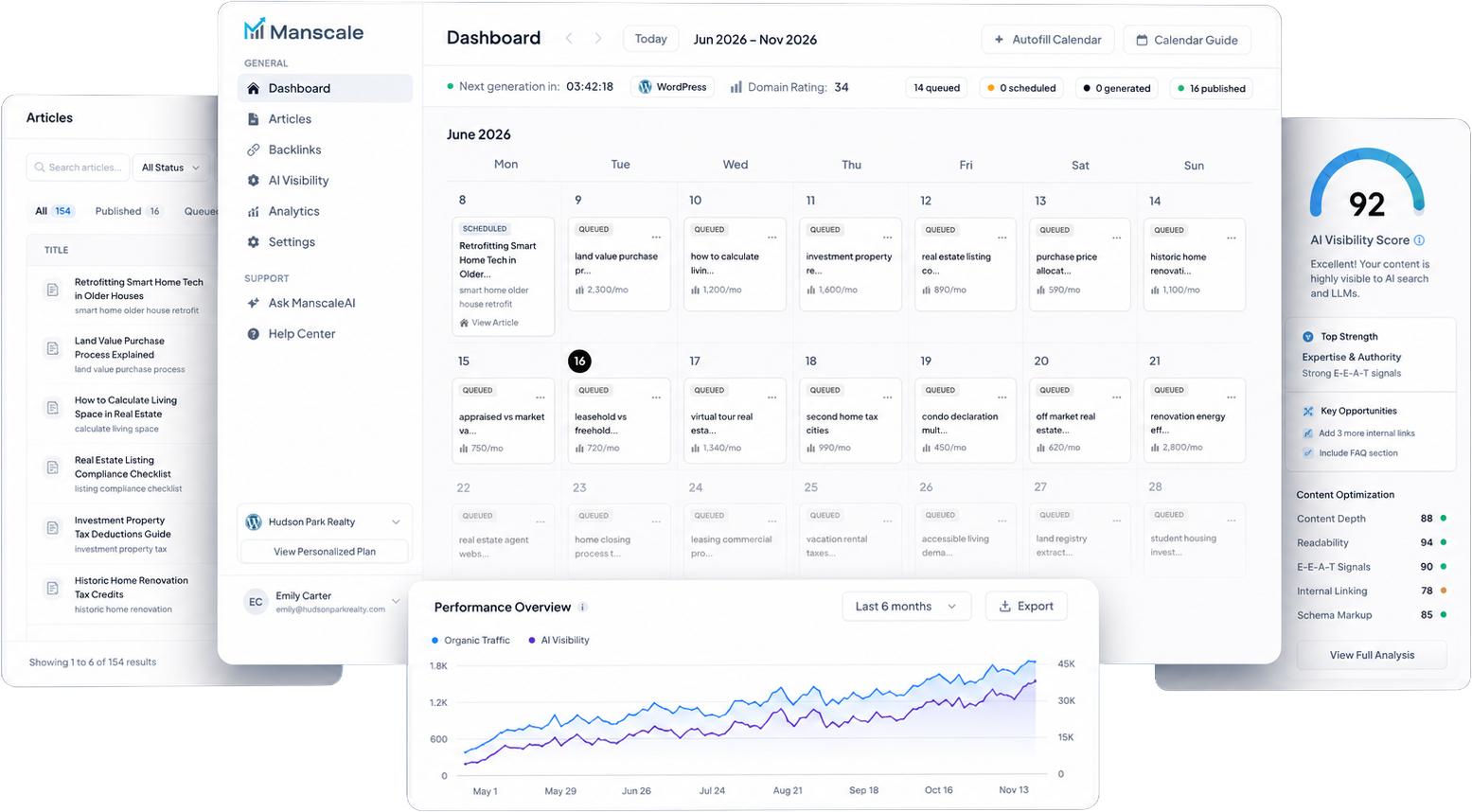
Platforms such as Manscale.Ai illustrate this broader operating model. The Seo Automation Saas researches keywords, creates and publishes Ai-generated articles daily, builds backlinks, and tracks Ai citations for websites running on WordPress, Shopify, Wix, or Webflow. The relevant distinction is clear: isolated generation produces documents; Content operations produce governed, traceable digital assets.
Design the workflow before you generate a draft
Start with workflow design. Many teams begin with a text generator and only later consider approvals, data sources, brand rules, or publication rights. That order invites errors. A reliable implementation starts by mapping the complete path from the initial query to the indexed URL.
A typical workflow includes topic discovery, keyword clustering, search-intent analysis, briefing, generation, fact-checking, editing, publication, and performance monitoring. Each stage needs a defined input, an accountable owner, and an acceptance criterion. For example, a brief should specify the primary query, supporting entities, audience, funnel stage, required evidence, internal-link targets, and prohibited claims before a draft is generated.
The beginner’s guide to Ai Content Automation from Nota provides useful introductory context. Operational maturity, however, begins when companies translate the concept into repeatable controls. A financial-services publisher may require human approval for every numerical claim. An e-commerce business might automatically publish category guides while routing product comparisons through legal and merchandising reviews.
The best Automation candidates are tasks that are frequent, rules-based, and easy to verify. Formatting title tags, adding schema fields, checking word duplication, or assigning internal links fits this profile. Interviews, original analysis, medical advice, and claims affecting purchasing decisions usually demand stronger human oversight.
Tools such as Make’s content-creation automation workflows can connect databases, language models, collaboration tools, and publishing platforms. Yet every additional connection creates another potential failure point. Teams should document authentication rules, data retention, retry behavior, and approval states before scaling.
A durable system also preserves an audit trail. Editors should be able to identify the source data, prompt version, model, reviewer, publication date, and subsequent changes behind each page. This record supports troubleshooting, compliance, and consistent editorial judgment across large Content libraries.
Direkt auf deiner Website
Hol dir einen 30-Tage-Contentplan für deine Website.
Quality gates that search engines actually reward
Search engines do not reward a page because artificial intelligence helped create it; they evaluate whether the page satisfies the user’s need. Automation must therefore reproduce the disciplines of a strong newsroom rather than bypass them.
A practical quality framework can be organized around six controls:
- Search intent: Determine whether users expect a guide, comparison, product page, definition, calculator, or local result. A detailed essay cannot compensate for the wrong page type.
- Source reliability: Use primary documents, official statistics, product specifications, or named experts whenever a claim can influence a decision.
- Editorial accuracy: Check names, dates, calculations, quotations, units, and causal claims. Numerical statements should be traceable to a source or an internal dataset.
- Information gain: Add material that competing pages do not provide, such as original examples, process data, expert commentary, screenshots, or a transparent methodology.
- Brand consistency: Encode approved terminology, tone, reading level, formatting conventions, and restricted claims in the production rules.
- Human escalation: Route sensitive subjects, uncertain facts, and high-value commercial pages to qualified reviewers instead of publishing them automatically.
These controls should function as gates, not suggestions. A draft missing a required source should remain unpublished. The same applies when a page duplicates an existing URL, lacks an assigned canonical, or fails a factual-confidence threshold. Structured rejection criteria prevent publication volume from becoming the primary success metric.
Templates also require restraint. Repeating the same introduction, subheadings, examples, and sentence patterns across hundreds of pages leaves a visible footprint and often produces shallow coverage. A better Content model defines required information while allowing variation in structure. A software comparison might always cover pricing, integrations, limitations, security, and ideal use cases, but the order and depth should reflect the products being evaluated.
Human review should be risk-based. A glossary definition with stable facts may need only a quick editorial check. A page discussing taxes, health, legal obligations, or financial returns requires specialist scrutiny and dated references. This allocation concentrates expertise where an error could cause genuine harm while allowing lower-risk production to move efficiently.
Quality architecture also includes maintenance. Product prices change, statistics become outdated, links break, and search behavior shifts. Automated monitoring can flag pages when a source exceeds a defined age, organic traffic falls sharply, or key facts no longer match a trusted database. That turns Content freshness into an operating process rather than an occasional cleanup project.
Direkt auf deiner Website
Soll so ein Artikel für deine Website entstehen? Starte den kostenlosen Quiz.
Measure publishing reliability, not just volume
A polished draft has no business value if the publishing pipeline creates broken URLs, missing metadata, indexing conflicts, or server errors. Content teams therefore need visibility into both editorial performance and infrastructure.
HTTP response codes offer a simple but concrete control layer. They are standardized signals returned when a browser, crawler, or Automation service requests a URL.
| HTTP status | Standard meaning | Operational interpretation | Recommended action |
|---|---|---|---|
| 200 | OK | The page is accessible and can be processed | Verify Content, canonical tag, and indexability |
| 301 | Moved Permanently | The URL permanently redirects to another location | Update internal links to the final destination |
| 404 | Not Found | The requested page does not exist | Restore the page, correct the URL, or redirect it |
| 429 | Too Many Requests | The system has exceeded a request limit | Apply rate limits, queues, and exponential retry delays |
| 500 | Internal Server Error | The publishing server failed to complete the request | Stop the workflow, log the failure, and alert an operator |
A production system should check these responses immediately after publication and again after a short delay. A 200 response alone is insufficient: the page may still contain a `noindex` directive, point to the wrong canonical URL, or omit essential structured data. Automated checks should also confirm the title, meta description, heading hierarchy, author information, publication date, image attributes, internal links, and sitemap inclusion.
Measurement must connect output with business outcomes. Publishing velocity shows operational capacity, but it does not reveal whether the Content performs. More useful indicators include the percentage of URLs indexed, non-brand impressions, qualified organic sessions, assisted conversions, revenue per landing page, backlink acquisition, and citations in Ai answer platforms.
Teams should establish a baseline before introducing Automation. Suppose a publisher produces 20 articles per month, 70% are indexed within 14 days, and 15% generate at least one qualified conversion within 90 days. After Automation, publishing 100 articles is not progress if indexing falls to 35% and conversion incidence drops to 4%. The relevant comparison is output multiplied by quality and commercial contribution—not volume in isolation.
Monitoring should operate at the URL, topic-cluster, and site levels. A single page may decline because its information is outdated; an entire cluster may weaken because competitors cover the subject more completely. Sitewide losses can indicate technical changes, poor internal linking, or an algorithmic reassessment. Separating these levels shortens diagnosis time.
A mature Seo dashboard also records production costs and editorial interventions. Cost per published page, correction rate, approval time, and percentage of drafts rejected reveal whether the workflow is genuinely becoming more efficient. Those measurements provide the evidence needed for the next stage: assigning ownership, setting governance rules, and deciding which publishing decisions must remain under human control.
Direkt auf deiner Website
Soll so ein Artikel für deine Website entstehen? Starte den kostenlosen Quiz.
Give automated publishing a named editorial owner

Clear ownership determines whether automated publishing becomes a controlled operating system or an expanding source of reputational risk. Every workflow needs a named editorial owner with authority to approve topics, define quality thresholds, and stop production. Technical teams may configure models and integrations, but they should not make final decisions about factual accuracy, brand positioning, or publication readiness.
A practical governance model separates responsibilities instead of assigning an ambiguous “human in the loop.” The person reviewing medical claims, for example, requires different expertise from the employee checking metadata or validating analytics events. For high-risk subjects such as health, finance, law, or workplace safety, a qualified specialist should approve substantive claims before publication.
The operating structure should specify:
- Content strategists define audience needs, search intent, formats, and business priorities.
- Subject-matter experts validate technical statements, examples, calculations, and recommendations.
- Editors assess structure, sourcing, originality, tone, and usefulness.
- Seo specialists review query targeting, internal links, metadata, and potential cannibalization.
- Automation engineers maintain prompts, APIs, model settings, and failure alerts.
- Legal or compliance reviewers examine regulated claims, disclosures, privacy issues, and intellectual property.
- Publishers confirm that every required approval is recorded before a page goes live.
Governance also requires an auditable record. For each asset, the system should retain the source brief, model version, prompt template, retrieved references, reviewer comments, approval status, and publication date. This audit trail makes errors easier to investigate and reveals whether a problem originated in the source material, model output, transformation logic, or human review.
Ai Content Automation works best when escalation rules are explicit. Unsupported statistics, conflicting sources, regulated advice, and unusually strong claims should automatically trigger senior review. Low-risk tasks—such as formatting approved copy or generating structured metadata—can proceed with lighter controls. Risk, not production volume, should determine the level of oversight.
Direkt auf deiner Website
Sieh, wie ManscaleAI den nächsten Artikel für deine Domain schreiben würde.
Connect research, drafting, publishing, and refresh

Automation creates measurable value when it connects the full Content lifecycle rather than accelerating an isolated writing task. A draft generated in seconds still becomes expensive if employees must manually copy it between spreadsheets, project-management tools, Content management systems, and analytics platforms. The larger opportunity lies in workflow orchestration: moving structured information through each stage while preserving context and approval history.
A robust workflow begins with a validated brief. Search demand, audience segment, funnel stage, product facts, approved sources, and conversion objective should enter the system as structured fields. Automated research can then cluster related queries, identify Content gaps, and distinguish informational searches from commercial ones. The process described in How Automated Keyword Research Turns Search Data Into a Scalable Seo Strategy illustrates how search data can support repeatable planning rather than one-off topic selection.
Drafting should follow modular templates that define required sections, evidence standards, prohibited claims, and formatting rules. AI Content Creation Automation provides examples of connecting generation tools with operational workflows. The critical distinction is that an integration should transfer both copy and production metadata, including Content ID, assigned reviewer, due date, target URL, and current status.
Once an editor approves the draft, the system can create the CMS entry, apply the appropriate schema fields, assign the author, and schedule publication. It should not publish automatically when required data is missing. A failed source check or empty legal-approval field must stop the workflow rather than produce a partially governed page.
Post-publication steps deserve equal attention. Ai Content Automation can verify indexability, test links, detect missing images, and confirm that analytics events fire correctly. Performance data should then return to the planning layer. This closed-loop workflow allows teams to refresh declining pages, expand topics with proven demand, and retire assets that no longer serve readers or business objectives.
Direkt auf deiner Website
Sieh, wie ManscaleAI den nächsten Artikel für deine Domain schreiben würde.
Control quality with the NIST risk framework
Quality control becomes more reliable when teams organize it around a recognized risk framework. The National Institute of Standards and Technology’s Ai Risk Management Framework 1.0, released in January 2023, defines four core functions: Govern, Map, Measure, and Manage. These are real operational categories, not a generic maturity scale, and they translate effectively into Content-production controls.
| NIST Ai RMF function | Function position | Application to Content operations | Required evidence |
|---|---|---|---|
| Govern | 1 | Establish policies, roles, accountability, and acceptable-use boundaries | Approval matrix and policy log |
| Map | 2 | Document context, audiences, intended use, and foreseeable harm | Content brief and risk classification |
| Measure | 3 | Test quality, accuracy, bias, security, and reliability | Evaluation results and reviewer notes |
| Manage | 4 | Prioritize risks, apply controls, monitor incidents, and improve processes | Incident register and corrective actions |
The framework is useful because it treats risk management as a continuous process. A publisher does not “complete” governance after drafting a policy. Controls must be tested against actual outputs, updated when models change, and strengthened when reviewers identify recurring defects.
Operational evaluations should examine several dimensions:
- Factual accuracy: Are names, dates, quotations, product specifications, and calculations correct?
- Source integrity: Can reviewers trace material claims to credible, current evidence?
- Intent satisfaction: Does the page answer the reader’s underlying task without unnecessary detours?
- Original value: Does it contribute analysis, experience, examples, or data beyond existing search results?
- Brand compliance: Are tone, terminology, legal language, and positioning consistent?
- Technical readiness: Do canonical tags, structured data, links, and indexation settings work as intended?
- Safety and fairness: Could the Content mislead, discriminate, expose personal data, or encourage harmful action?
Sampling must reflect risk. Reviewing 10% of low-stakes product-tag descriptions may be reasonable when defect rates remain stable. By contrast, every page containing financial projections or health recommendations should receive expert review. Teams should also establish release gates based on observed error rates rather than intuition. If citation failures exceed the agreed threshold, publishing pauses until the source-retrieval or prompt logic is corrected.
This control structure turns Ai Content Automation into a monitored production process. It also generates comparable evidence across Content types, models, and teams, enabling managers to distinguish isolated editorial errors from systematic workflow failures.
Direkt auf deiner Website
Soll so ein Artikel für deine Website entstehen? Starte den kostenlosen Quiz.
Count cost per approved page, not tokens
A credible business case measures the cost of usable, published Content—not the price of model tokens or the number of drafts generated. Token expenses can be negligible while research, correction, expert review, design, compliance, and CMS work remain substantial. The correct financial unit is cost per approved asset, accompanied by production time and post-publication performance.
Consider a team that spends three hours on a conventional article at a blended labor cost of $60 per hour. Its direct production cost is $180 before design and distribution. If Automation reduces drafting time by 45 minutes but adds 30 minutes of fact-checking, the net saving is only $15 per article. That may still be worthwhile at scale, but it is materially different from claiming a 75% reduction because the first draft appeared faster.
Managers should calculate the complete cost with a consistent formula:
Total production cost = research + generation + editing + expert review + design + publishing + quality assurance + software allocation.
The same discipline applies to returns. Traffic alone is an incomplete measure because a page can attract visits without generating qualified leads, subscriptions, assisted revenue, or product adoption. Performance reporting should connect each Content ID to organic conversions, sales-pipeline influence, engagement quality, and maintenance cost. For informational pages, useful indicators may include newsletter sign-ups, return visits, or progression to commercial pages.
A controlled pilot provides better evidence than an immediate sitewide rollout. Select comparable topic groups, maintain similar editorial standards, and compare automated and conventional workflows over at least one complete reporting cycle. Track median production time, correction rate, approval rate, indexing success, organic entrances, and conversions. Small samples should not drive broad investment decisions; one unusually successful page can distort the average.
Ai Content Automation also introduces ongoing expenses that budget models often omit. Prompt libraries require maintenance, integrations fail, model behavior changes, and older pages need fresh verification. A realistic unit-economics model includes those costs and assigns them across published assets. The next operational question is therefore not simply how much Content the system can produce, but how teams should test models, prompts, and retrieval methods without exposing the live site to uncontrolled experiments.
Direkt auf deiner Website
Hol dir einen 30-Tage-Contentplan für deine Website.
Test models on real briefs before they reach the live site

Safe experimentation separates scalable publishing systems from high-volume Content risks. Before a new model, prompt, or retrieval method reaches a live website, teams should test it in a controlled environment using representative assignments. That means working with actual product data, search intents, brand requirements, and compliance constraints—not generic sample prompts that conceal operational weaknesses.
A practical testing framework should evaluate more than grammatical quality. The guide What Is Content Automation? A Simple Guide for Marketers explains how automated workflows connect Content tasks and tools; those connections also create failure points that require systematic validation. For Ai Content Automation, each test should measure accuracy, editorial effort, production speed, and the frequency of unsupported claims.
A reliable evaluation process includes:
- Factual accuracy: Verify names, dates, statistics, product specifications, quotations, and cited sources against primary evidence.
- Search alignment: Confirm that the draft addresses the query’s intent rather than merely repeating target terms. Automated keyword research can provide scalable search data, but editors must still interpret the underlying need.
- Brand consistency: Compare terminology, tone, formatting, and claims with an approved editorial style guide.
- Retrieval quality: Test whether the system uses current, authorized sources and rejects irrelevant or outdated material.
- Human editing time: Record the minutes required to bring each draft to publication standard. This exposes false efficiency gains.
- Risk severity: Classify errors by impact. An awkward sentence is minor; incorrect medical, financial, or legal guidance can create substantial liability.
Teams should run these checks on a fixed sample—such as 30 briefs across commercial, informational, and support Content—before comparing systems. A useful acceptance threshold might require 98% verified factual claims, zero prohibited statements, and a median editing time below 20 minutes per 1,000 words. Version-controlled prompts and dated test results create an audit trail, allowing decision-makers to identify whether performance changed after a model update. Only configurations that meet predetermined standards should advance to limited production, followed by monitored rollout rather than immediate sitewide deployment.
Direkt auf deiner Website
Sieh, wie ManscaleAI den nächsten Artikel für deine Domain schreiben würde.
Scale only when quality and cost both hold
Ai Content Automation delivers its strongest results when treated as an operating system for Content production, not as a shortcut for generating more pages. The technology can accelerate keyword analysis, briefing, drafting, repurposing, distribution, and Content refreshes. Yet speed has limited business value unless the resulting assets remain accurate, distinctive, useful, and aligned with measurable audience demand.
The economic case therefore depends on disciplined execution. Leaders should calculate total production cost, including software, integration maintenance, fact-checking, editorial review, and updates after publication. They should also monitor qualified traffic, conversion contribution, assisted revenue, and Content decay instead of relying on word count or publishing frequency. A smaller library of authoritative pages can outperform thousands of thin, overlapping URLs.
Distribution deserves the same rigor as creation. The practical methods outlined in How to Automate Your Social Media Content with AI show how Automation can extend approved material across social channels. However, every derivative post still needs channel-specific context, current information, and human oversight.
Successful Ai Content Automation combines structured data, clear governance, dependable workflows, and accountable editors. Organizations should define ownership for prompts, sources, approvals, corrections, and performance reporting before increasing output. They should also retain human judgment for original reporting, strategic positioning, sensitive claims, and final publication decisions.
The next step is concrete: select one repeatable Content workflow, establish a baseline for cost and quality, test it with a controlled batch, and review the results after 30 days. Scale only when the evidence demonstrates higher editorial efficiency without sacrificing trust.
Direkt auf deiner Website
Hol dir einen 30-Tage-Contentplan für deine Website.