How Automated Keyword Research Turns Search Data Into a Scalable Seo Strategy
Automated Keyword Research can reduce days of spreadsheet work to hours, but speed is only valuable when the resulting terms reflect real customer demand.…

Dieser Artikel ist aktuell nur auf Englisch verfügbar.

Automated Keyword Research can reduce days of spreadsheet work to hours, but speed is only valuable when the resulting terms reflect real customer demand. A strong workflow combines search data, commercial context, and editorial judgment rather than accepting every suggestion an algorithm produces.
The practical advantage is scale. Software can expand hundreds of seed terms, collect search volume, identify ranking difficulty, classify intent, and organize related queries before an analyst reviews the first spreadsheet. That allows Seo teams to spend less time copying metrics and more time deciding which topics can generate qualified traffic, revenue, or brand authority.
Automation also supports continuous Research. Search behavior changes as products launch, competitors publish new pages, and buyers adopt different language. A static Keyword file created six months ago may miss emerging questions or retain terms that no longer matter. Automated workflows can refresh those findings weekly or monthly and flag material changes.
Platforms approach the process from different angles. The Free Keyword Tool: Find the Right Keywords for SEO & AI ... provides database-driven discovery and competitive metrics, while Keyword Research Automation. Seed to Strategy in Minutes. focuses on moving from initial terms toward a structured strategy. In either case, experienced review remains the control that separates useful intelligence from a large, polished list.
What Is Automated Keyword Research?
Automated Keyword Research is the use of software-driven workflows to discover, enrich, categorize, and prioritize search queries. The process may combine commercial Seo platforms, search-engine APIs, custom scripts, machine-learning models, and generative AI. Its purpose is not merely to produce more keywords. It turns fragmented query data into a structured set of opportunities that can guide site architecture, content production, product pages, and paid campaigns.
How Keyword Research Automation Works
A workflow usually begins with seed keywords drawn from products, services, customer questions, or existing pages. Software expands those inputs through related terms, autocomplete suggestions, competitor rankings, and semantically connected entities. APIs then add metrics such as volume, cost per click, ranking difficulty, trend direction, and current position.
Machine-learning models can classify search intent as informational, commercial, transactional, or navigational. Clustering systems compare SERP overlap, semantic similarity, or both to group terms that can reasonably be targeted on one page. A scoring model may then weigh business relevance, ranking feasibility, traffic potential, and conversion value.
The tasks best suited to Automation include:
- Large-scale Keyword expansion
- SERP data and metric collection
- Intent classification and topic clustering
- Duplicate removal and normalization
- Opportunity scoring and recurring reports
Automation Versus Traditional Manual Research
Manual Research offers context that software often lacks. An experienced analyst can recognize that a high-volume term attracts students rather than buyers, that two similar queries require different landing pages, or that a low-volume phrase signals a valuable enterprise need.
Automated Keyword Research handles repeatable processing more efficiently, while analysts make strategic decisions. Human review should validate clusters, examine live search results, identify brand or legal risks, and determine whether the company has enough expertise to satisfy a query. The strongest operating model is therefore supervised Automation: machines process scale; people assess meaning, value, and editorial fit.
Direkt auf deiner Website
Soll so ein Artikel für deine Website entstehen? Starte den kostenlosen Quiz.
Why Automate the Keyword Discovery Process?
The business case rests on throughput and decision quality. Automated Keyword Research allows a team to evaluate thousands of queries under one methodology instead of researching a few hundred terms through inconsistent spreadsheet routines. Faster cycles mean campaigns can move from discovery to content briefs sooner, while scheduled refreshes reveal new demand without requiring a complete quarterly rebuild.
Efficiency and Scalability Benefits
Automation broadens topic coverage because the cost of processing each additional Keyword falls sharply once the workflow is established. Agencies can run comparable analyses across client accounts. Enterprise Seo teams can map demand across countries, departments, and product lines. Ecommerce businesses can process category, brand, model, feature, and use-case combinations at catalog scale.
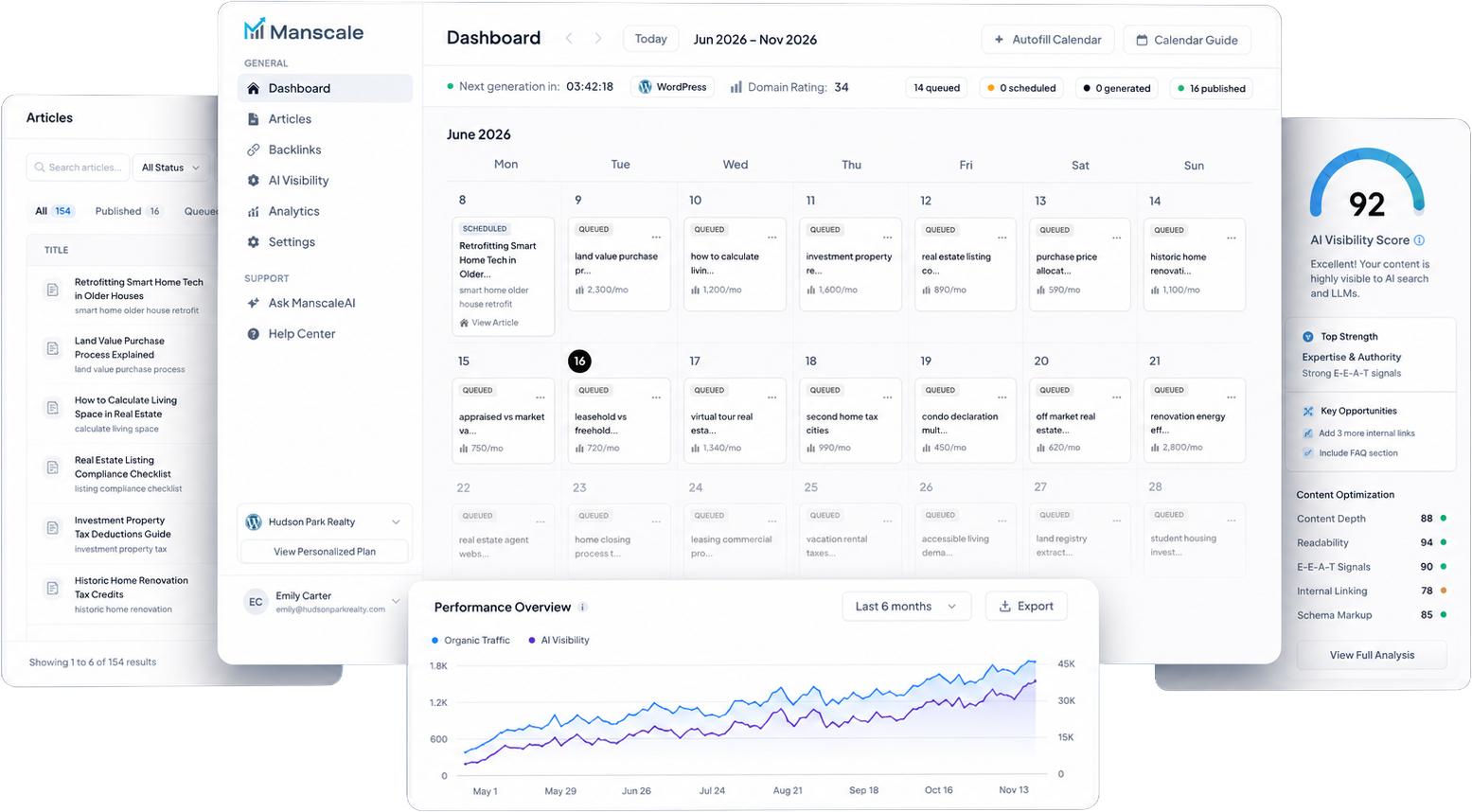
Content marketers gain a prioritized editorial pipeline rather than an unfiltered export. Smaller teams benefit as well: one Seo manager can monitor opportunities that would otherwise require several analysts. Platforms such as Manscale.ai extend this operating model beyond discovery. The Seo Automation Saas researches keywords, creates and publishes AI-generated articles daily, builds backlinks, and tracks AI citations for sites on WordPress, Shopify, Wix, and Webflow. That broader Automation makes quality controls especially consequential because weak Research can affect every downstream activity.
A manual process has typically become a bottleneck when:
- Research takes several days for each campaign or market.
- Analysts repeatedly copy Keyword metrics between tools.
- Different team members apply conflicting scoring rules.
- Topic maps become outdated before content is published.
- Large product catalogs receive incomplete query coverage.
- Reporting depends on fragile, manually maintained spreadsheets.
Consistency Across Campaigns and Teams
A defined scoring framework gives every campaign the same baseline. Teams can standardize how they measure relevance, demand, difficulty, conversion potential, and content fit. This improves governance and makes recommendations easier to audit.
Consistency does not mean rigid uniformity. A new software company may accept lower-volume queries with strong purchase intent, while a national publisher may prioritize reach and topical authority. Automation should apply the rules selected for each business model, preserve the source data, and document why one opportunity ranks above another. Analysts can then revise assumptions without rebuilding the entire dataset.
Direkt auf deiner Website
Soll so ein Artikel für deine Website entstehen? Starte den kostenlosen Quiz.
Core Data Sources and Keyword Inputs
Reliable Automated Keyword Research depends less on the size of a Keyword export than on the diversity and quality of its inputs. First-party sources show how real prospects interact with the business. Third-party sources expose broader market behavior, competing pages, and demand the site has not yet captured.
First-Party Search and Customer Data
Google Search Console provides queries, clicks, impressions, average position, and click-through rate for searches in which the site already appears. Paid search reports add conversion and cost data, helping identify language associated with revenue rather than traffic alone. Site search logs reveal what visitors expect to find after arriving, while analytics connects landing pages with engagement, leads, and sales.
Customer conversations provide another layer. Sales-call transcripts can expose objections, desired features, and industry terminology. Support tickets often reveal specific troubleshooting questions that Keyword databases underestimate. These sources are especially useful for B2B, technical, and niche markets where reported search volumes may be sparse.
| Source | Data type | Primary use | Strengths | Limitations |
|---|---|---|---|---|
| Google Search Console | Queries, clicks, impressions, position | Find existing visibility and striking-distance terms | Direct first-party Google performance data | Limited historical range and partial query reporting |
| Paid search reports | Queries, CPC, conversions, cost | Validate commercial demand | Connects language with measurable outcomes | Influenced by bids, budgets, and campaign settings |
| Site search and analytics | Internal queries, sessions, conversions | Identify visitor needs and page performance | Specific to the site’s actual audience | Requires sufficient traffic and clean tracking |
| Sales calls and support tickets | Questions, objections, product language | Discover customer-led topics | Rich qualitative context and precise terminology | Unstructured and potentially biased toward existing customers |
| Competitor pages and SERP sources | Rankings, titles, snippets, SERP features | Identify coverage gaps and result formats | Shows the current competitive landscape | Does not reveal a competitor’s conversions or strategic priorities |
Third-Party Platforms and SERP Sources
Competitor pages show which themes other publishers consider valuable, but copying their Keyword targets is not a strategy. Analysts should compare those pages with autocomplete suggestions, People Also Ask results, trend data, and Keyword databases. Autocomplete captures frequently associated wording; People Also Ask surfaces adjacent questions; trend tools show seasonality and momentum; databases provide standardized estimates for volume, difficulty, and paid competition.
At minimum, a viable workflow needs:
- A focused list of products, services, audiences, and seed topics
- Google Search Console data or another source of first-party query performance
- A Keyword database with volume, difficulty, and cost-per-click data
- Current SERP results for intent and competitor validation
- Conversion evidence from analytics, paid search, sales, or CRM records
These inputs should retain timestamps, countries, devices, and source labels. Without that metadata, teams can easily compare incompatible figures—for example, national desktop volume with local mobile performance—or mistake a temporary trend for durable demand.
Direkt auf deiner Website
Soll so ein Artikel für deine Website entstehen? Starte den kostenlosen Quiz.
Building an End-to-End Automation Workflow

From Seed Topics to Enriched Keyword Sets
An effective Automated Keyword Research workflow begins with a documented objective: organic traffic growth, qualified lead generation, ecommerce sales, local visibility, or content-gap discovery. That objective determines the market, language, device, time frame, and metrics to collect. Teams then supply seed topics from product categories, customer interviews, site-search logs, paid-search queries, competitor pages, and Search Console data.
Expansion can combine autocomplete suggestions, related searches, question databases, competitor rankings, and Keyword APIs. Each Keyword should be enriched with search volume, ranking difficulty, cost per click, SERP features, current position, trend data, and source metadata. A spreadsheet may serve as the review layer while no-code platforms coordinate requests among APIs, cloud storage, and reporting tools. The workflow described in Automate keyword research with Make and DataForSEO API illustrates how those services can exchange structured data without manual copying.
Cleaning, Deduplication, and Standardization
Raw lists require data normalization before analysis. Convert text to lowercase for matching, trim spaces, standardize singular and plural handling, preserve the original query, and assign consistent country, language, currency, and date fields. Exact duplicates can be removed automatically; near-duplicates should remain until intent and SERP overlap are evaluated.
Python scripts are useful for processing hundreds of thousands of rows, while SQL databases provide dependable storage, joins, and version history. Smaller projects can use spreadsheet formulas and extensions. No-code services handle scheduling and notifications, but critical jobs need retry logic, API timeout rules, validation checks, and an error log.
Use predictable file names such as `us-software-keywords-2026-09-11-v03`, along with stable column names and documented metric definitions. A repeatable template should record credentials ownership, API limits, filters, exclusion lists, and export formats. Daily or weekly schedules are appropriate for volatile markets; quarterly refreshes may be sufficient for evergreen topics.
Direkt auf deiner Website
Sieh, wie ManscaleAI den nächsten Artikel für deine Domain schreiben würde.
Choosing Automated Keyword Research Tools
Essential Features and Integrations
Tool selection should reflect the workflow rather than brand recognition. Dedicated Seo suites provide broad databases and accessible interfaces. Generative AI tools excel at topic expansion and labeling but do not independently supply dependable demand figures. Keyword APIs deliver structured records at scale, browser scrapers capture visible SERP evidence, and spreadsheet extensions support fast analysis by nontechnical teams. No-code services connect these components, as outlined in Automating keyword research.
| Tool category | Typical use case | Setup effort | Practical scalability | Customization | Data reliability | Relative cost |
|---|---|---|---|---|---|---|
| Dedicated Seo suite | Ongoing Research and competitor analysis | 1–2 hours | 10,000–100,000 keywords per project | Medium | High when country and date are controlled | $$$ |
| Keyword API | Large-scale enrichment and monitoring | 1–3 days | 100,000+ requests with batching | High | High; dependent on provider methodology | $$–$$$$ |
| Spreadsheet extension | One-off lists and editorial planning | 30–90 minutes | Usually below 20,000 rows | Medium | Medium to high | $–$$ |
| No-code Automation service | Scheduled multi-app workflows | 2–8 hours | Moderate; constrained by operation quotas | High | Depends on connected sources | $$–$$$ |
| Python script with scraper | Custom SERP collection and classification | 3–10 days | High with queues and proxies | Very high | Variable; markup changes can break collection | $$ plus engineering |
Matching Tools to Budget and Technical Skill
Automated Keyword Research platforms should be tested for API rate limits, row caps, export restrictions, historical coverage, and regional databases. A provider with excellent US data may offer limited visibility for smaller countries or city-level searches. Teams should also verify authentication methods, webhook support, documentation quality, and compatibility with their database or business-intelligence platform.
A small editorial team may favor a suite or spreadsheet extension because maintenance remains low. Agencies and marketplaces often benefit from APIs, scripts, and database pipelines that can process many domains consistently. A fixed-price entry point such as Manscale AI - 49 EUR can also be evaluated against expected query volume, export needs, and staff time rather than subscription price alone.
Browser scrapers require particular caution. Search engines change page structures, personalize results, and enforce access restrictions. Any implementation needs lawful collection practices, throttling, monitoring, and a fallback source. The least expensive tool can become costly when undocumented failures corrupt months of Research.
Direkt auf deiner Website
Soll so ein Artikel für deine Website entstehen? Starte den kostenlosen Quiz.
Classifying Search Intent and Clustering Keywords

Automating Intent Classification
Search intent is not reliably captured by individual words such as “buy” or “guide.” Rules provide a useful first pass: pricing language often signals commercial intent, store names suggest navigational intent, and “near me” commonly indicates local intent. However, the ranking pages reveal what search engines currently consider relevant.
Automated Keyword Research systems can compare the top 10 results for each query. If two terms share six or seven ranking URLs, they probably address the same underlying need. Natural language processing identifies entities and modifiers, while embeddings measure semantic similarity. Large language models can classify informational, commercial, transactional, navigational, and local queries, but classifications should retain a confidence score and SERP evidence. This prevents an articulate model response from being mistaken for verified search behavior.
Creating Topic Clusters Without Cannibalization
Clustering should combine semantic similarity with SERP overlap. Semantic models may group “enterprise Seo platform” with “Seo software,” yet the first query may return procurement pages while the second favors broad product lists. Shared ranking pages expose that distinction.
A practical review process is:
- 1 Group keywords using embeddings, shared entities, and common modifiers.
- 2 Calculate overlap among the top-ranking URLs, using a threshold such as three shared results in the top 10.
- 3 Inspect mixed or low-confidence clusters manually for differences in format, audience, location, or funnel stage.
- 4 Select one primary Keyword that best represents demand, intent, and business relevance.
- 5 Assign close variants and supporting questions as secondary terms for the same page.
- 6 Separate keywords when SERPs favor different page types, such as a category page, comparison page, tutorial, or local landing page.
- 7 Map every approved cluster to an existing or planned URL before drafting content.
This URL map limits Keyword cannibalization by preventing multiple pages from targeting the same intent. It also reveals genuine content opportunities: a product page may cover transactional demand, while a separate implementation guide answers informational questions without competing for the same rankings.
Direkt auf deiner Website
Sieh, wie ManscaleAI den nächsten Artikel für deine Domain schreiben würde.
Scoring and Prioritizing Keyword Opportunities
Balancing Demand, Difficulty, and Business Value
Search volume measures estimated demand, not attainable traffic or commercial impact. A 20,000-search informational query may produce few clicks because of answer boxes, videos, or dominant publishers. A 500-search term tied to a high-value service can generate more revenue when the page matches transactional intent.
Automated Keyword Research should therefore combine volume with ranking difficulty, current position, organic click potential, conversion relevance, topical authority, seasonality, strategic value, and content effort. Current positions from 4 through 20 often deserve special attention because an existing page may improve faster than a new page can establish authority. Seasonal scores should use comparable year-over-year periods rather than a single monthly spike.
Designing a Custom Opportunity Score
The following worked model normalizes each input to a 0–100 scale. Attainability combines inverse difficulty with current ranking proximity; effort efficiency rewards opportunities that require fewer production resources.
| Sample Keyword | Demand 20% | Attainability 15% | Click potential 15% | Business value 25% | Topical authority 10% | Effort efficiency 15% | Final score |
|---|---|---|---|---|---|---|---|
| Automated Keyword Research software | 72 | 55 | 78 | 95 | 70 | 65 | 74.9 |
| Keyword clustering tool | 68 | 62 | 82 | 80 | 76 | 72 | 73.6 |
| free Keyword generator | 95 | 35 | 48 | 40 | 52 | 85 | 59.4 |
| Seo API for agencies | 50 | 70 | 75 | 98 | 88 | 60 | 74.1 |
The calculation is `Demand × 0.20 + Attainability × 0.15 + Click Potential × 0.15 + Business Value × 0.25 + Topical Authority × 0.10 + Effort Efficiency × 0.15`. Scores should then receive a documented seasonal adjustment when demand varies materially by month.
Weights must follow business constraints. A new publisher may emphasize attainability and production effort. An established software company can assign more weight to conversion relevance and strategic product alignment. Local businesses should elevate geographic fit, while ecommerce teams may incorporate margin, inventory, and repeat-purchase rates. Recalculate the model when resources, authority, or commercial priorities change; otherwise, an apparently objective score will continue rewarding outdated goals.
Direkt auf deiner Website
Soll so ein Artikel für deine Website entstehen? Starte den kostenlosen Quiz.
Quality Control for Automated Keyword Research
Common Automation Errors and Data Gaps
Automated Keyword Research accelerates discovery, but its outputs remain estimates rather than verified demand signals. Search-volume figures may be inaccurate, averaged across several months, or based on outdated datasets. Tools can also group phrases with different meanings, overlook regional demand, or recommend irrelevant AI-generated terms. A query containing a company name creates further brand ambiguity when the system cannot distinguish navigational searches from category interest.
Other distortions are less obvious. Multiple keywords may represent the same search intent, inflating the apparent opportunity. High-volume queries can produce zero-click results because answer boxes, maps, or AI summaries satisfy users directly on the results page. Meanwhile, a low Keyword difficulty score may ignore entrenched brands, specialized topical authority, or SERP features that suppress organic clicks. Practical workflows such as How to Automate Keyword Research should therefore be treated as operating frameworks—not substitutes for editorial judgment.
Human Review and SERP Validation
A defensible quality-control process combines sampling, live evidence, and business context. Before keywords enter a content roadmap, teams should complete the following checks:
- Randomly sample at least 10% of generated terms and verify search volume, geography, language, and freshness.
- Inspect live Google results to identify SERP features, ranking formats, dominant brands, and probable click potential.
- Confirm whether each phrase reflects informational, commercial, transactional, or navigational intent.
- Consolidate duplicates that would otherwise create Keyword cannibalization or redundant briefs.
- Ask sales, product, legal, and customer-support stakeholders to flag irrelevant language and missed customer terminology.
- Recalibrate models quarterly—or sooner after major algorithm, market, or product changes.
Automated Keyword Research also requires sound data governance. Scraping must respect robots directives, rate limits, copyright restrictions, and platform API terms. Sensitive query, customer, or account data should be minimized, access-controlled, and retained only when necessary. Guidance on Automated Keyword Research with AI to Uncover Hidden ... can expand discovery methods, but generated output still needs traceable sources and human approval. Blind acceptance turns Automation from an efficiency gain into a scalable error system.
Direkt auf deiner Website
Soll so ein Artikel für deine Website entstehen? Starte den kostenlosen Quiz.
Turning Automation Into a Repeatable Seo Advantage
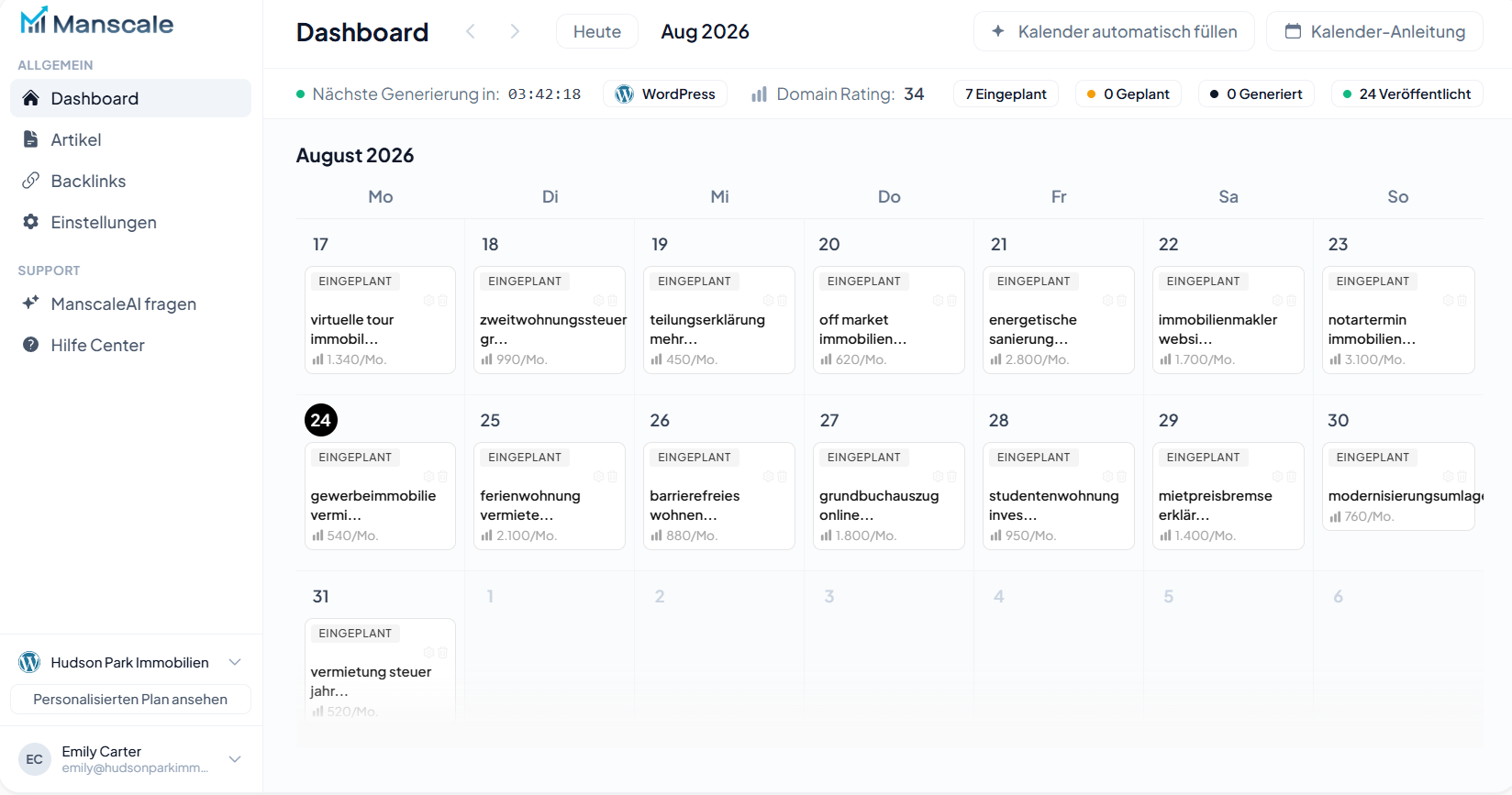
Automated Keyword Research creates durable value when it operates as a controlled business process: collect reliable inputs, cluster by intent, score against commercial priorities, validate the live SERP, and measure results after publication. The strongest systems connect ranking potential with revenue relevance, production capacity, geographic fit, and the likelihood of earning an actual click.
Consistency matters more than sheer Keyword volume. Document data sources, scoring weights, exclusions, review decisions, and refresh schedules so teams can reproduce results and diagnose performance changes. Services such as Manscale AI - 49 EUR can support an operational workflow, but ownership of strategy, privacy, and final editorial decisions must remain with accountable professionals.
The competitive advantage comes from the feedback loop. Compare forecasts with impressions, clicks, conversions, and assisted revenue; then use those findings to improve future prioritization. Automated Keyword Research becomes repeatable only when every cycle produces better data and sharper judgment. Start with one market or product category, establish a reviewed baseline, and recalibrate the system after the first 60 to 90 days of performance data.
Direkt auf deiner Website
Sieh, wie ManscaleAI den nächsten Artikel für deine Domain schreiben würde.