How Automated Seo Software Turns Repetitive Tasks Into Scalable Workflows
Automated Seo Software replaces hours of spreadsheet work, manual audits, and repetitive checks with workflows that can inspect thousands of URLs on a fixe…

Dieser Artikel ist aktuell nur auf Englisch verfügbar.

Automated Seo Software replaces hours of spreadsheet work, manual audits, and repetitive checks with workflows that can inspect thousands of URLs on a fixed schedule. Its practical value is not simply speed. The Software gives Seo teams a consistent operating system for finding technical defects, prioritizing opportunities, assigning work, and measuring whether changes produced results.
A useful platform may connect Google Search Console, analytics, rank-tracking, crawling, content, and publishing data in one environment. That integration allows teams to detect a traffic decline, identify affected pages, compare rankings, and issue an alert without manually reconciling several exports. The strongest implementations combine reliable data, explicit business rules, and human review rather than treating Automation as an unattended ranking machine.
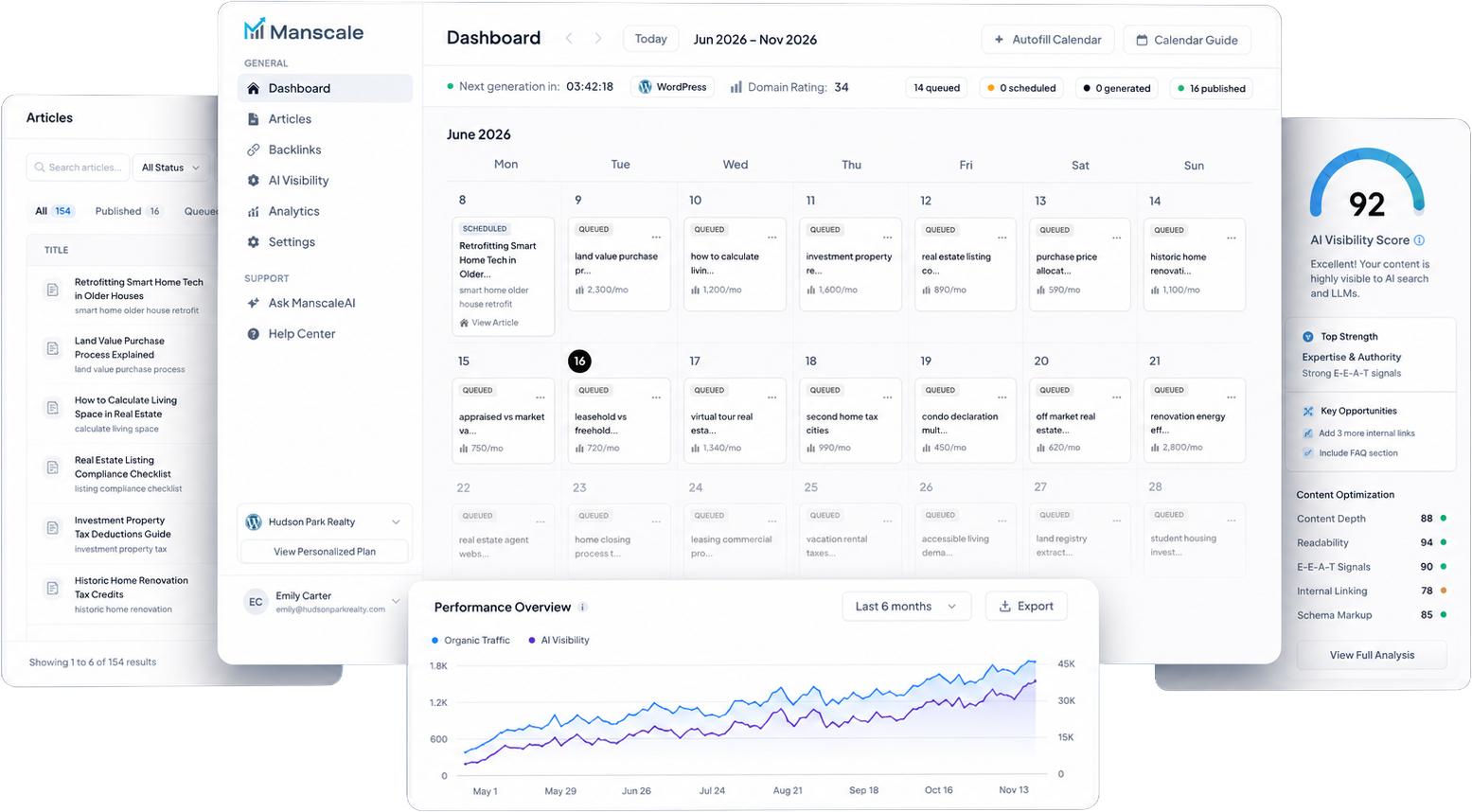
Capabilities vary considerably. The market includes technical crawlers, content optimization products, reporting suites, and systems that execute multistep processes. Zapier’s overview of The 11 Best SEO Tools in 2026 illustrates how differently platforms approach research, auditing, competitive analysis, and reporting. Manscale.ai represents a broader Automation model: it researches keywords, creates and publishes AI-generated articles daily, builds backlinks, and tracks AI citations across websites using WordPress, Shopify, Wix, and Webflow. Such breadth can reduce operational friction, but editorial standards and strategic accountability still belong to experienced professionals.
Automated Seo Software Turns Repetitive Optimization Tasks Into Scalable Workflows
How Seo Automation Collects Data and Triggers Actions
Automated Seo Software connects data sources, evaluates incoming information against rules or AI models, and produces a recommendation or action. A workflow might crawl a website every Monday, identify pages returning a 404 status, check whether those URLs have internal links, and send prioritized tickets to the technical team. More advanced systems can draft replacement metadata, recommend internal links, or publish approved content through a content management system.
Most products fall into four practical categories:
- All-in-one platforms combine keyword research, rank tracking, auditing, content analysis, and reporting.
- Specialized point solutions handle a narrow function such as crawling, schema validation, or internal linking.
- Browser-based tools analyze search results, pages, or on-page elements during research and editing.
- Enterprise systems integrate multiple domains, permission levels, data warehouses, and approval workflows.
- AI-agent platforms coordinate several applications and trigger multistep actions from defined instructions.
A detailed example of this workflow approach appears in SEO automation made simple with AI agents, where agents support research and recurring operational processes.
The Difference Between Automation, AI Assistance, and Full Autonomy
Task Automation follows predetermined instructions: crawl these URLs, flag missing titles, or refresh this dashboard. AI assistance interprets data and generates outputs, such as keyword clusters or content briefs, but normally requires validation. Full autonomy goes further by selecting and executing changes with little or no approval.
These models carry different risk levels. Scheduled rank collection is predictable; automatically rewriting 20,000 product descriptions is not. Governance should therefore match the consequence of an error. Low-risk monitoring can run unattended, while publishing, redirects, canonical changes, and link acquisition should include quality controls, approval thresholds, audit logs, and rollback procedures.
Direkt auf deiner Website
Soll so ein Artikel für deine Website entstehen? Starte den kostenlosen Quiz.
The Best Automation Opportunities Are High-Volume, Repeatable Seo Tasks
Tasks That Can Be Reliably Automated
The best candidates have structured inputs, clear outputs, and objective failure conditions. Automated Seo Software performs especially well when the same check must be applied across hundreds or millions of pages. A crawler does not become fatigued after reviewing 50,000 canonical tags, and a reporting workflow does not forget a monthly deadline.
The following suitability ratings use a five-point operational scale, where 5 indicates highly repeatable work with limited interpretive risk:
| Seo task | Automation suitability | Typical cadence | Human review requirement |
|---|---|---|---|
| Scheduled site crawling | 5/5 | Daily or weekly | Review prioritized defects |
| Broken-link detection | 5/5 | Daily or weekly | Confirm redirect destination |
| Rank monitoring | 5/5 | Daily or weekly | Interpret material movement |
| Metadata validation | 4/5 | After each release | Approve rewritten copy |
| Keyword clustering | 3/5 | Per research cycle | Validate intent and overlap |
Additional high-value workflows include:
- 1 Technical alerts for indexability changes, server errors, and accidental `noindex` directives.
- 2 Internal-link suggestions based on topical relevance and existing anchor usage.
- 3 Reporting Automation that consolidates traffic, visibility, conversions, and issue status.
- 4 Schema checks for missing, invalid, or inconsistent structured data.
- 5 Content inventory updates that identify decay, duplication, and pages requiring review.
- 6 Release monitoring that compares crawl data before and after site deployments.
Strategic Decisions That Still Need Human Oversight
Search intent cannot always be reduced to a keyword label. A query may appear transactional while the results favor guides, calculators, or comparison pages. An experienced strategist must examine the search results, user journey, business model, and likelihood of conversion before commissioning content.
Human judgment is also essential for brand positioning, editorial standards, digital PR, and sensitive outreach. Software can find prospects, but it cannot reliably assess whether a publication is credible, whether a proposed angle is newsworthy, or whether outreach could damage a brand’s reputation.
Ambiguous algorithm changes require similar restraint. A simultaneous decline in rankings and traffic may result from seasonality, stronger competitors, altered search features, tracking defects, or a broad Google update. Automated diagnosis can surface correlations; it cannot establish causation without supporting evidence. Teams should use Automation to narrow the investigation, then apply editorial judgment, customer knowledge, and technical expertise before taking action.
Direkt auf deiner Website
Soll so ein Artikel für deine Website entstehen? Starte den kostenlosen Quiz.
Automated Seo Software Improves Speed and Consistency but Does Not Guarantee Rankings
Operational Benefits for Teams and Agencies
Automated Seo Software can compress work that once required several analysts into a repeatable process. Scheduled crawls expand site coverage, templates standardize audit criteria, and alerts expose defects before they remain unnoticed for weeks. Agencies also benefit from lower reporting overhead: metrics can be collected, normalized, and delivered across multiple client accounts without rebuilding dashboards every month.
Consistency is equally valuable. When every website is assessed with the same technical checks, severity definitions, and escalation rules, teams can compare performance and allocate resources more rationally. Shared dashboards and assigned tasks improve cross-functional collaboration among Seo specialists, editors, developers, and executives. Audit logs add accountability by showing what changed, when it changed, and which workflow initiated the action.
Earlier detection can reduce commercial damage. For example, an alert about a newly blocked product category may reach a team within hours, whereas a manual monthly audit could discover the same problem weeks later.
Why Efficiency Gains Do Not Equal Search Performance
No platform can guarantee rankings, organic traffic, conversions, or protection from search engine updates. Automation improves execution capacity; it does not control competitors, search demand, Google’s systems, or user behavior.
Results depend first on data quality. Incomplete analytics, inconsistent URL parameters, inaccurate rank locations, or delayed Search Console data can lead to weak recommendations. Implementation matters just as much. A technically correct content brief creates no value if the resulting page is generic, inaccurate, or never published.
Competition also sets the performance threshold. A small retailer entering a search category dominated by established publishers may need original research, expert commentary, stronger product differentiation, and authoritative links—not merely more content. Technical execution remains decisive as well: slow rendering, poor internal architecture, duplicate pages, and unreliable structured data can undermine otherwise strong editorial work.
Effective teams judge Automation by operational and business metrics, including time saved, issues prevented, qualified organic sessions, assisted conversions, and revenue contribution. Those measurements provide the evidence needed to refine workflows, adjust approval rules, and determine where additional human expertise is warranted.
Direkt auf deiner Website
Hol dir einen 30-Tage-Contentplan für deine Website.
Core Features Should Match Technical, Content, and Reporting Priorities

Essential Capabilities to Evaluate
The right feature set follows the operating model, not the longest vendor checklist. Technical teams need reliable site crawling, internal-link analysis, on-page recommendations, and alerts for indexability problems. Editorial teams gain more value from keyword research, content briefs, competitor tracking, and optimization guidance. Executives usually require dashboards, scheduled reports, and integrations that connect organic performance with leads or revenue.
Automated Seo Software should also support backlink monitoring and rank tracking across the search engines, countries, devices, and locations relevant to the business. Data freshness matters: daily rankings may be justified for volatile commercial queries, while weekly updates can serve stable informational portfolios. Before comparing products, buyers can review independent roundups such as 12 Best Automated Seo Software Tools for 2026 (Tested) and 13 best SEO automation tools I'm using in 2026, then verify every claim during a controlled trial.
| Use case | Core capability | Evidence to verify | Typical buyer |
|---|---|---|---|
| Technical auditing | Full crawl and indexability checks | JavaScript rendering, canonical validation, crawl limits | Enterprise Seo team |
| Content planning | Keywords, briefs, and competitor analysis | Database coverage, intent classification, export quality | Publisher or content team |
| Performance monitoring | Rankings, links, and alerts | Update frequency, location accuracy, historical depth | In-house growth team |
| Client reporting | Dashboards and scheduled reports | Custom branding, data connectors, PDF and CSV exports | Agency |
| Seo operations | Rules, APIs, and QA checks | Error handling, permissions, audit history | Large or regulated organization |
Advanced Features That May Justify a Higher Price
Large websites may benefit from log-file analysis, forecasting, custom rules, API access, and Automated quality assurance. These capabilities can identify wasted crawl activity, estimate traffic upside, or flag releases that introduce broken canonicals.
Agencies should examine white-label reporting, while enterprises need role-based permissions and auditable access controls. A premium is defensible when these functions replace manual work or prevent costly defects—not when they merely expand an unused feature inventory.
Direkt auf deiner Website
Sieh, wie ManscaleAI den nächsten Artikel für deine Domain schreiben würde.
Choosing a Platform Requires Testing Data Quality, Usability, and Total Cost
A Buyer’s Checklist for Comparing Vendors
Procurement should begin with measurable goals: reducing technical defects, increasing publishing capacity, improving rankings, or consolidating reporting. Site size then determines practical requirements. A retailer with five million URLs has different crawl and storage needs than a professional-services firm with 2,000 pages.
Evaluate Automated Seo Software against the following checklist:
- Confirm crawl limits, overage charges, rendering options, and crawl-frequency controls.
- Compare keyword allowances, supported search engines, geographic databases, devices, and update frequency.
- Test integrations with Google Search Console, analytics, content management, business intelligence, and project-management systems.
- Calculate total cost across user seats, API consumption, onboarding, training, support, and data retention.
- Review security documentation, data residency, encryption, single sign-on, permission levels, and incident-response procedures.
- Examine renewal clauses, cancellation rights, price increases, service commitments, and data-export terms.
A platform may appear inexpensive until additional locations, users, projects, or daily updates trigger higher tiers. Buyers should model the expected 12-month cost rather than comparing introductory monthly prices.
How to Run a Meaningful Trial or Pilot
Use a representative site section containing known issues: broken internal links, duplicate titles, incorrect canonicals, redirect chains, and pages with declining traffic. Compare the platform’s findings with Google Search Console, analytics records, server logs, and a trusted manual crawl. Recommendation volume is not the same as recommendation accuracy.
Likely users—including Seo specialists, editors, developers, and analysts—should complete real assignments during the pilot. Measure detection accuracy, false positives, task completion time, and reporting clarity. Resources such as How an Ai Seo Platform Turns Search Data Into Growth Priorities can help teams frame outputs around commercial priorities rather than isolated scores.
Document support response times as well. A technically capable product loses operational value when users cannot resolve failed crawls, connector errors, or unexplained data discrepancies.
Direkt auf deiner Website
Soll so ein Artikel für deine Website entstehen? Starte den kostenlosen Quiz.
A Structured Rollout Prevents Automation From Creating More Seo Problems

Build the Workflow Before Enabling Automatic Actions
Implementation should start with an audit of current workflows, responsibilities, data sources, and recurring failures. Define objectives in operational terms—for example, cutting audit time by 40% or detecting release-related indexability defects within two hours. Automated Seo Software should initially address a few high-value use cases rather than every available process.
A controlled rollout can follow six stages:
- 1 Map existing workflows, dependencies, approval points, and baseline performance.
- 2 Prioritize use cases according to business impact, technical risk, and implementation effort.
- 3 Clean keyword, URL, analytics, and conversion data before connecting systems.
- 4 Configure rules, thresholds, notifications, integrations, and named owners.
- 5 Test on one directory, market, template, or content category.
- 6 Review accuracy and business impact before expanding scope gradually.
Limited testing reveals whether rules behave correctly under real conditions. It also exposes conflicts between crawl data, analytics platforms, content systems, and release processes before those conflicts affect an entire domain.
Use Approval Gates, Ownership, and Documentation
Changes to templates, canonical tags, redirects, structured data, robots directives, or published content require formal approval gates. Technical Seo may approve canonical logic, engineering may own deployment, and editorial leadership may authorize substantive copy changes. The system should never leave accountability ambiguous.
Every Automated action needs a rollback plan, timestamped change log, responsible owner, and defined success metric. Staging environments allow teams to inspect rendered pages, status codes, internal links, and schema output before deployment.
Training should cover more than interface navigation. Users need to understand rule logic, confidence scores, failure modes, and escalation procedures. Documentation must identify whom to contact when an Automated change causes traffic loss, indexing disruption, or publishing errors. That operating discipline makes gradual scaling safer and gives reviewers the evidence needed to distinguish correlation from genuine causation.
Direkt auf deiner Website
Sieh, wie ManscaleAI den nächsten Artikel für deine Domain schreiben würde.
AI-Driven Recommendations Need Guardrails for Accuracy, Brand Safety, and Compliance
Common Risks of Automated Content and Technical Changes
AI recommendations can sound authoritative while relying on incomplete evidence. Risks include fabricated facts, outdated guidance, duplicate or thin copy, keyword stuffing, biased outputs, and over-optimization that reduces readability. At scale, small errors become portfolio-wide liabilities.
Technical Automation introduces equally serious hazards. An incorrect redirect rule can remove valuable URLs from search results; a template modification can break thousands of pages; and faulty structured data can generate policy violations. Data sent to external models may also expose customer information, unpublished materials, or proprietary performance records.
Automated Seo Software must not become a mechanism for mass-producing low-value pages. Search engines assess whether content serves users, and scaled content abuse can violate spam policies regardless of whether text was written by a person, generated by a model, or assembled through templates.
Controls That Keep Humans Accountable
High-impact recommendations should pass human review and source verification. Claims involving prices, law, health, finance, product specifications, or named organizations require primary evidence. Editors should reject outputs that cannot identify a credible source or that merely restate ranking pages without adding original value.
Access controls should follow least-privilege principles. Staging environments, confidence thresholds, audit logs, and deployment approvals create separation between recommendation and execution. Low-risk metadata suggestions may enter a review queue automatically; sitewide redirects should require technical and business authorization.
Periodic manual audits remain necessary even when Automated quality checks report no errors. Reviewers should sample published pages, inspect rendered templates, validate redirects, and compare logs with recorded actions. Security teams should also examine vendor retention policies, model-training terms, and integration permissions. These controls preserve traceability while allowing Automation to handle repetitive analysis without transferring judgment to an opaque system.
Direkt auf deiner Website
Hol dir einen 30-Tage-Contentplan für deine Website.
Performance Measurement Must Connect Automated Work to Traffic, Revenue, and Time Saved
Operational Metrics Show Whether Automation Is Working
Measurement should begin before implementation. Record a four-to-eight-week pre-implementation benchmark for manual effort, crawl coverage, reporting speed, and average issue-resolution time. Automated Seo Software can then be evaluated against the same workload rather than against assumptions or vendor projections.
Useful operational metrics include hours saved, issues detected, recommendation acceptance rates, percentage of priority URLs crawled, and time from detection to verified resolution. A reduction from 16 reporting hours to four, for example, represents a measurable 75% efficiency gain. The What is SEO automation? Complete 2026 guide provides additional context for selecting repeatable tasks without removing necessary oversight.
Business KPIs Reveal Whether Seo Outcomes Improve
Efficiency alone does not establish value. Automated Seo Software must also improve qualified organic traffic, nonbrand visibility, conversions, revenue, lead quality, and indexed-page performance. Teams comparing platforms can Navigate the SEO Automation Tools Landscape while maintaining a scorecard such as the following:
| Automation use case | Baseline metric | Target KPI | Review frequency | Responsible owner |
|---|---|---|---|---|
| Technical issue detection | 14-day discovery lag | Under 24 hours | Weekly | Technical Seo lead |
| Issue remediation | 12-day resolution time | 5 days or less | Biweekly | Engineering manager |
| Crawl monitoring | 72% of priority URLs covered | At least 95% | Weekly | Seo analyst |
| Recommendation workflow | 38% acceptance rate | At least 65% | Monthly | Seo director |
| Performance reporting | 16 staff hours per month | 4 hours or less | Monthly | Analytics lead |
Revenue attribution remains imperfect because organic conversions may involve paid, direct, email, or AI-search touchpoints. Use assisted conversions, CRM lead quality, and controlled before-and-after comparisons rather than claiming that every gain came from Automation.
Direkt auf deiner Website
Soll so ein Artikel für deine Website entstehen? Starte den kostenlosen Quiz.
Automated Seo Software Works Best as a Controlled Layer Within a Human-Led Strategy
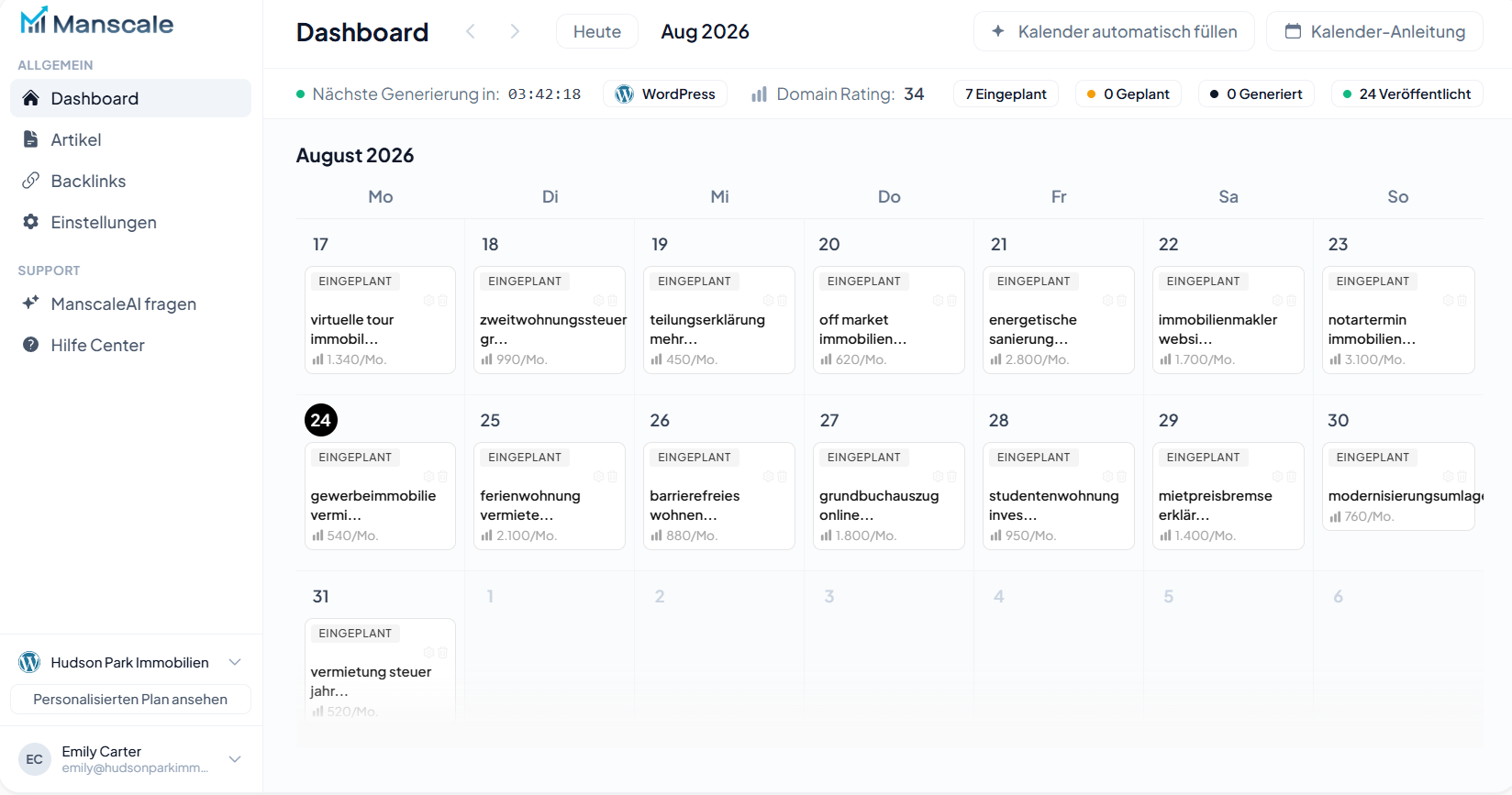
Automated Seo Software creates the most value when it handles repetitive collection, classification, monitoring, and reporting while specialists retain control over priorities and publication. The technology can surface thousands of crawl anomalies or keyword opportunities quickly; it cannot independently determine whether a recommendation supports the brand, satisfies search intent, or introduces legal and commercial risk.
A reliable operating model combines documented approval thresholds, role-based permissions, audit logs, rollback procedures, and scheduled manual reviews. Technical fixes with limited risk may proceed through a supervised workflow. Redirects, canonical changes, generated copy, and alterations to revenue-critical templates require accountable human approval. The same discipline should govern platform selection: teams need transparent pricing, integration requirements, data-retention terms, and evidence that outputs improve business results. How an Ai Seo Platform Turns Search Data Into Growth Priorities explains how centralized search intelligence can support that decision process.
The strongest programs judge Automated Seo Software by time saved, implementation quality, organic growth, conversion performance, and revenue—not by the number of recommendations produced. Establish the baseline, assign an owner to every workflow, and begin with one measurable use case. Expand only after the system demonstrates reliable gains under human supervision.
Direkt auf deiner Website
Sieh, wie ManscaleAI den nächsten Artikel für deine Domain schreiben würde.